AI phishing simulations that mirror real attacks
Train employees with realistic, role-relevant scenarios they will actually encounter. Boost security awareness without manual campaign setup.
Teams loved our cybersecurity solution:





...and more.
Adaptive security
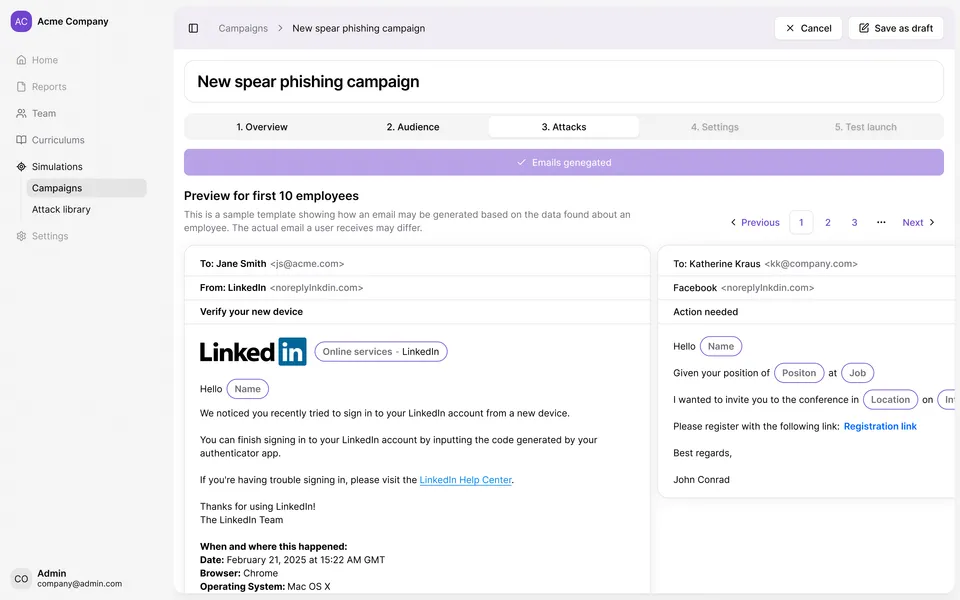
Simulations automatically match employee roles and department responsibilities to save admin time.
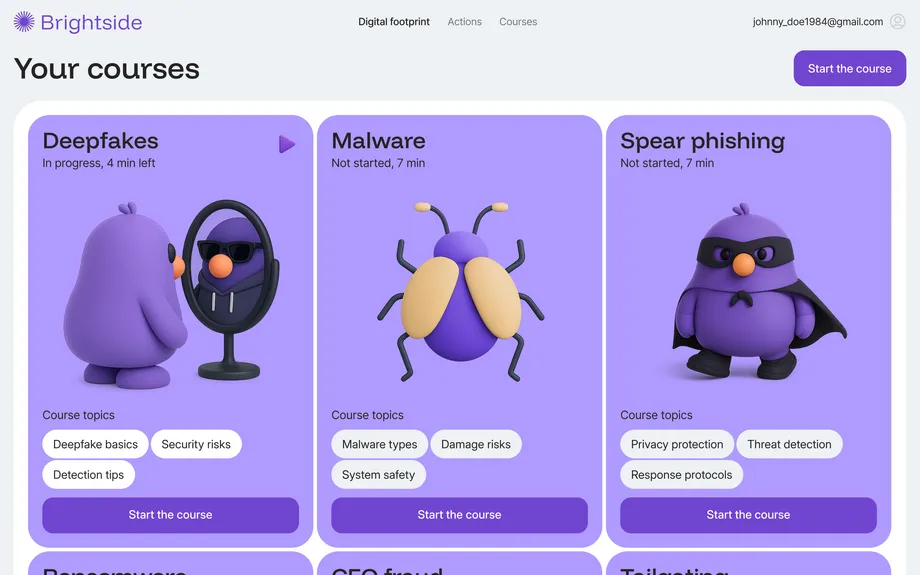
AI scenario generation
Launch attack simulations using professional templates or custom AI-generated lures.
Flexible deployment
Deploy campaigns efficiently by targeting dynamic groups or selecting specific employee cohorts.
Custom analytics
Build custom reports that map directly to your compliance and regulatory requirements.
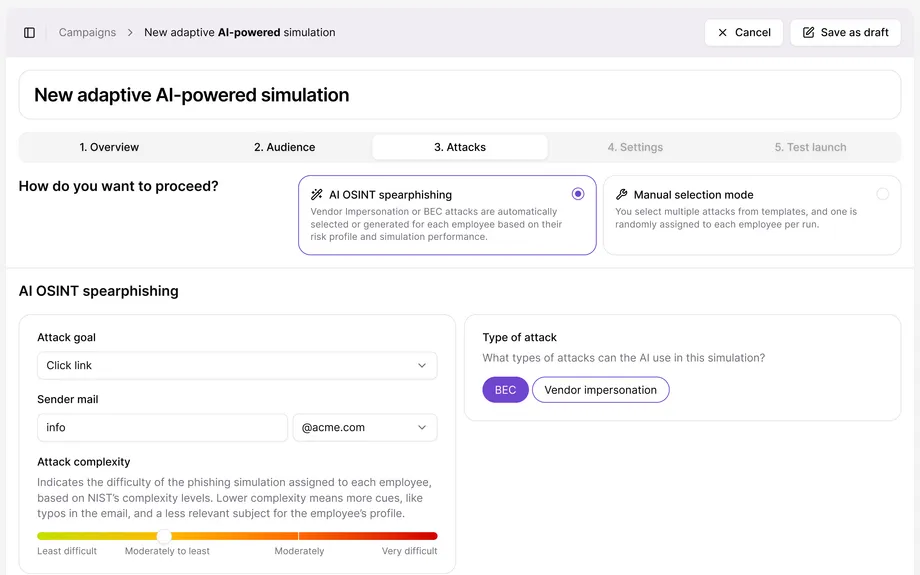
Targeted AI OSINT spear-phishing
AI generates convincing role-specific attacks using employee context like job titles and daily tools. Adjust difficulty from basic awareness to advanced spear-phishing using the NIST Phish Scale.
Call us & start trial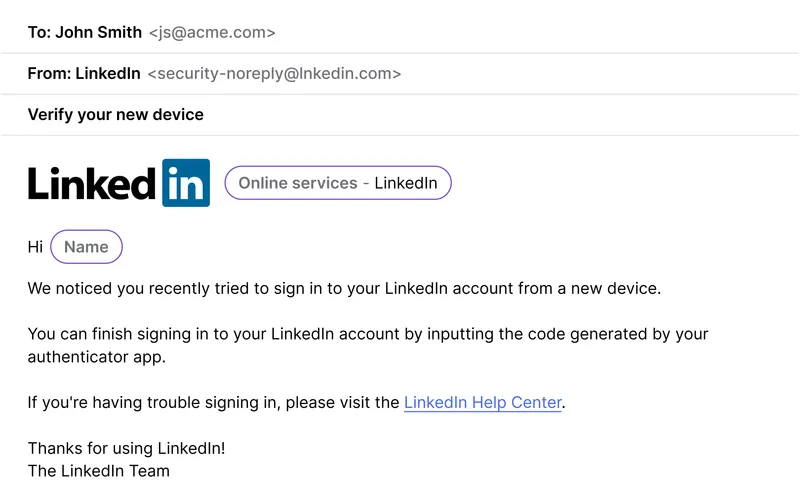
BEC and vendor impersonation
Simulate executive compromise and trusted vendor scenarios. Test whether employees submit credentials on fake login pages or act on fraudulent invoice requests from familiar sources.
Call us & start trial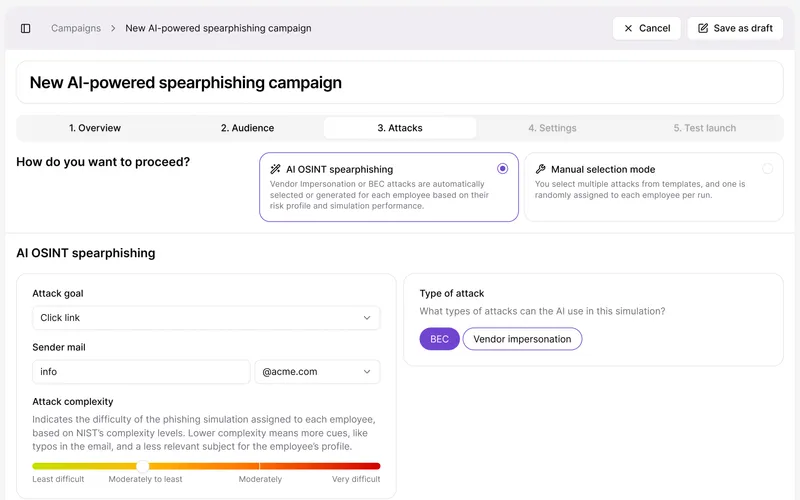
Measure real employee behavior
Track opens, clicks, credential submissions, and reports. Hidden honeypot links separate security scanner activity from human actions, keeping bot clicks from inflating failure rates.
Call us & start trial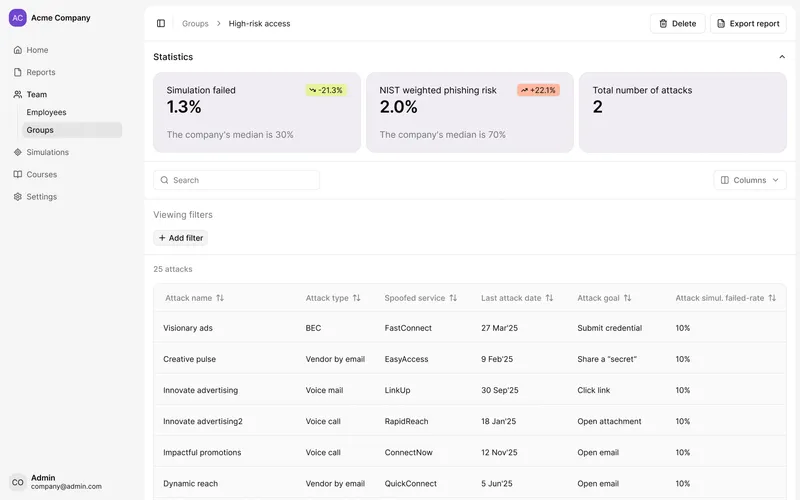
Enterprise integrations
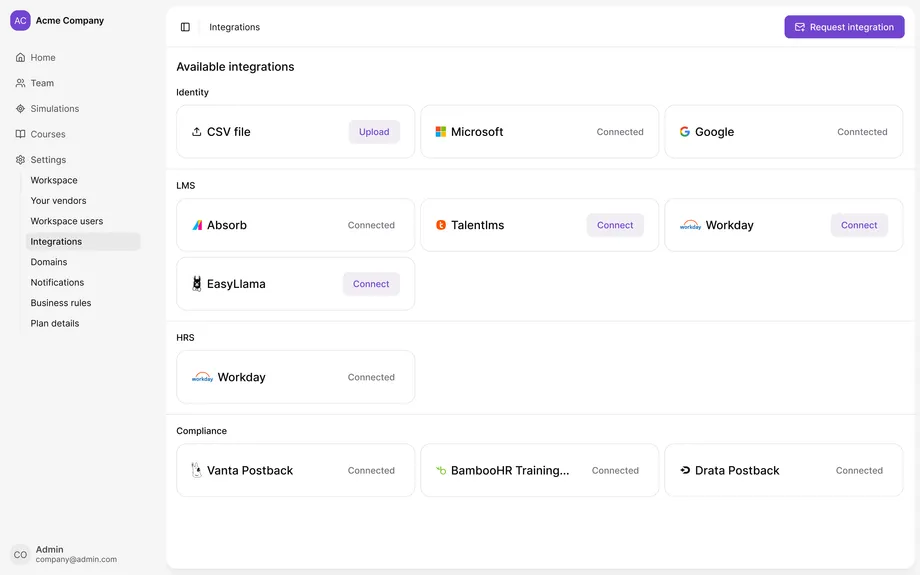
Pre-built integrations with Google Workspace, Microsoft 365, Okta, and Vanta enable rapid deployment and automated user provisioning. Custom HR system connectors are available on demand, and 36+ integrations are coming soon.
Scalable plans
Plans for every organization size
Start free and scale with flexible pricing.
Let's talk enterprise solutionsStart
Free
Plan features:
- Courses.
Basic
from €0.5/ m. per seat
Plan features:
- Courses.
- Template simulations.
Pro
from €1.3/ m. per seat
Plan features:
- Courses.
- Template simulations.
- AI OSINT spear-phishing simulations.
- AI-powered vishing simulations.
Vishing (standalone)
from €1/ m. per seat
Features:
- Voice-only and hybrid attack simulations (voice + email).
- Multilingual voice library with custom voice cloning.
- Granular scenario builder for custom tactics, urgency levels, and caller personas.
- AI-assisted scenario creation.
- Detailed analytics tracking with one-click CSV export.
Ask AI about Brightside
Let ChatGPT, Gemini or Perplexity share what they know. Click a button and see what your favorite AI says about Brightside.



What is a phishing simulation?
A phishing simulation is a safe, simulated phishing attack sent to employees to measure how they respond to a deceptive email. It identifies who clicks, submits credentials, or reports the message, letting you find risky behavior and train it before real attackers exploit it.
How do you reduce employee phishing click rates?
You reduce phishing click rates by running regular, role-based simulations and assigning short training the moment someone fails. With progressive difficulty and in-context micro-learning, organizations running continuous programs typically fall below a 5% click rate, versus roughly 30% for untrained staff.
How does Brightside automate role-based spear-phishing campaigns?
Our platform leverages employee profile data—such as job title, department, tenure, and daily software tools. The AI automatically selects and personalizes the most relevant attack template. This ensures your finance team receives convincing vendor invoices while marketing gets relevant ad platform alerts, all without any manual configuration.
How do you control the difficulty of the phishing simulations?
All of our email templates—including our highly targeted AI-powered OSINT spear-phishing simulations—are strictly aligned with the NIST Phish Scale. This allows administrators to structure campaigns with progressive difficulty, moving employees from basic spam recognition to identifying advanced, open-source intelligence-driven spear-phishing attempts as their awareness improves.
What specific types of phishing scenarios can we simulate?
Our template library is extensive. You can simulate Business Email Compromise (BEC), CEO/executive fraud, and highly specific vendor impersonation (targeting your actual vendors, consumer apps, or widely trusted brands). Furthermore, attacks are categorized by department fit (Sales, Finance, Legal, IT) and geography. We also cover advanced credential harvesting, such as fake login pages, password reset links, and SSN extraction, as well as hybrid attacks that combine a phishing email with a trackable AI voice call.
How does the platform prevent employees from spotting repetitive tests?
Brightside's automation prevents simulation fatigue. An employee will never receive the exact same attack twice. Additionally, once a specific sender domain is used in a simulation against an employee, our system enforces a strict, automatic 3-month cooling period for that domain across all workspaces before it can be used against them again.
What happens exactly when an employee clicks a phishing link?
Brightside handles this with automated remediation. The simulation tracks five distinct actions: Delivered, Opened, Clicked, Entered credentials, and Reported. If an employee fails by clicking a link, opening an attachment, or submitting data, the platform instantly assigns a bite-sized, relevant micro-learning module. This turns the failure into an immediate teachable moment without requiring manual intervention from your team.